



Which 2026 Ford Super Duty F-250 engine works best for heavy towing near Worthington, OH?
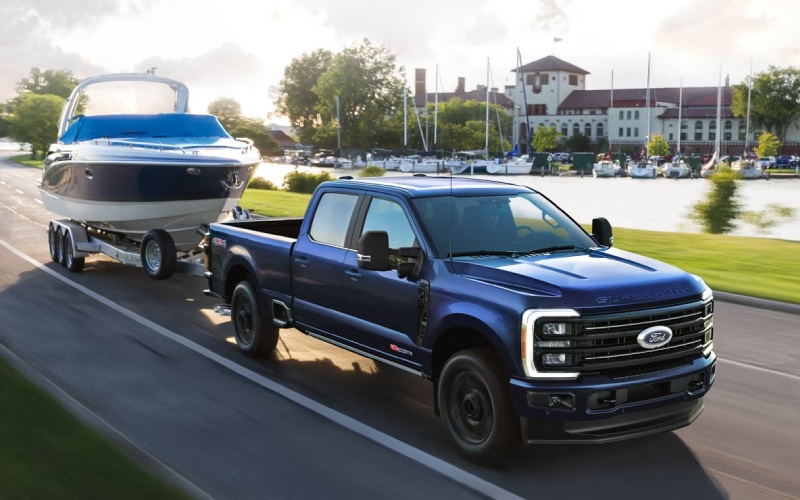
Valley Ford of Columbus – Which 2026 Ford Super Duty F-250 engine works best for heavy towing near Worthington, OH?
Choosing the right engine is the most important decision you’ll make when building your 2026 Ford Super Duty® F-250®. If your daily life includes equipment trailers, construction materials, or a camper that sees plenty of highway time around Worthington, OH, getting the powertrain right will set the tone for the entire ownership experience.
Below, we’ll break down how the major engines in the F-250® lineup stack up for towing, hauling, and everyday usability. We’ll also cover when a gas V8 is the perfect fit and when the 6.7L Power Stroke® diesel shines brightest, so you can choose with confidence.
The Gas V8s vs. The Diesels
The 2026 Super Duty® F-250® offers four engines: the 6.8L 2V DEVCT NA PFI V8 gas, the 7.3L 2V DEVCT NA PFI V8 gas, the 6.7L 4V OHV Power Stroke® V8 Turbo Diesel B20, and the 6.7L High Output Power Stroke® V8 Turbo Diesel B20. Each pairs with a 10-speed transmission and selectable drive modes to put power down smoothly under changing loads and grades.
The 7.3L gas V8 is a favorite for drivers who split time between towing, commuting, and weekend projects. It’s rated at 430 horsepower at 5,500 rpm and 485 lb-ft of torque at 4,000 rpm, which gives you authoritative acceleration and easy merging with a moderate-size trailer. Response is immediate, and maintenance is straightforward—qualities many owner-operators appreciate. If you tow frequently but not at the outer limits, the 7.3L strikes a superb balance of capability and everyday simplicity.
For sustained heavy towing—long grades on I-270, frequent gooseneck or 5th-wheel work, or a fully loaded work trailer most days—the Power Stroke® diesels step in. The High Output variant leads the Super Duty® family with best-in-class diesel horsepower and torque, peaking at up to 500 horsepower and 1,200 lb-ft of torque. That mountain of low-end torque keeps you composed off the line and stable at speed. If your trailer weight approaches the higher end of what an F-250® build is designed to handle, the diesel will make the job feel easier, day after day.
How Towing Tech Changes the Equation
Whichever engine you pick, Ford’s available towing technologies can dramatically reduce stress and speed up your workflow. Available Pro Trailer Hitch Assist™ uses camera guidance and steering assistance to help you line up the coupler quickly—especially helpful when you change trailers often or load up in crowded spaces. Available Pro Trailer Backup Assist™ lets you dial in the direction you want the trailer to go while the system helps manage steering inputs. Add Onboard Scales with Smart Hitch, and you can estimate cargo and tongue weight to help balance your load more accurately—key for stability and tire life.
These systems don’t replace good technique, but they add an edge of confidence that’s hard to overstate, particularly for shoppers moving into heavier trailers or those who frequently hitch alone.
Workday Power Without the Generator
Another decision point when choosing an engine is on-site power. While available 2kW Pro Power Onboard™ isn’t tied to a single engine, it’s one of the most underrated productivity features you can add, regardless of your fuel type. With in-bed outlets, you can run saws, charge batteries, and light up a staging area without hauling a standalone generator. For contractors working variable jobs across Central Ohio, it’s the kind of feature you use more than you expect.
Payload vs. Towing: What Matters More?
F-250® buyers often walk a fine line between payload needs and towing requirements. The Super Duty® family leads with best-in-class payload and diesel towing when properly configured, but the ideal setup for you depends on what you carry most. If you frequently load the bed with dense materials or tools and carry a moderate trailer, a gas V8 can be a smart, well-rounded choice. If the trailer is the main event—especially heavy 5th-wheel or gooseneck loads—a Power Stroke® diesel will provide the muscle and calm you feel through the wheel on cross-county runs.
Real-World Tips Before You Decide
Before committing to a build, take a careful inventory of your trailer lineup and routes around Worthington, OH. Then test-drive the 7.3L gas V8 and a Power Stroke® diesel back-to-back on similar roads. Pay attention to throttle response, braking feel, and how the 10-speed manages grades. Ask to demo available Pro Trailer Hitch Assist™ and Pro Trailer Backup Assist™ with a trailer attached to see how these systems will support your daily routine. Finally, look at interior productivity features—available SYNC® 4 with a 12″ center display, head-up display, and the Interior Work Surface—so your cab works like a rolling office between sites.
Who Should Choose Which Engine?
- Frequent heavy towing: The 6.7L High Output Power Stroke® V8 Turbo Diesel B20 provides the strongest low-end torque and sustained pulling power.
- Mixed-use towing and commuting: The 7.3L 2V DEVCT NA PFI V8 gas engine delivers responsive performance and simplicity for varied days.
- Light-to-moderate trailering with higher payload needs: Consider a gas configuration tailored to bed capacity and axle ratio.
- Fleet and jobsite versatility: Pair your chosen engine with available 2kW Pro Power Onboard™ and towing tech to maximize uptime and ease of use.
Each of these paths can be optimized further with axle choices, cab and bed configurations, and off-road packages like Tremor® or FX4® if you’re frequently on unimproved lots or rural access roads.
Putting It All Together
The smart play is to spec from your real numbers—actual trailer weights, typical cargo, and how often you’re towing at or near capacity. Bring that detail to a test drive, and you’ll quickly feel which engine aligns with your work and drives the way you prefer. Valley Ford of Columbus can walk you through these trade-offs and set up a route that mirrors your daily driving so you get a clear picture before you order.
Frequently Asked Questions:
Will the 7.3L gas V8 handle my 10,000 lb trailer reliably?
Yes. The 7.3L gas V8 is a strong match for many trailers in the 8,000–12,000 lb range, offering responsive acceleration and confident merging. If you frequently exceed that, or tow at the upper end of F-250® configurations, the 6.7L Power Stroke® diesel may be the better fit.
Is the diesel worth it if I only tow on weekends?
If your weekend towing involves heavier 5th-wheel or gooseneck loads or long highway climbs, the diesel’s torque and composure can be worth it. For lighter, occasional towing and more daily commuting, the 7.3L gas V8 is often the more balanced choice.
How do Ford’s towing features help if I’m an experienced tower?
Available Pro Trailer Hitch Assist™ speeds up hookup, and Pro Trailer Backup Assist™ can help reduce stress in tight spaces. On busy days, these time-savers and visibility aids free you to focus on safety and workflow.
Can I power tools from the truck?
Yes. With available 2kW Pro Power Onboard™, you can run tools and lights from in-bed outlets, which is especially useful on job sites without reliable power.

0 comment(s) so far on Which 2026 Ford Super Duty F-250 engine works best for heavy towing near Worthington, OH?